Five takeaways from COP31: turning climate ambition into action
Read more

The question on business leaders’ minds: how can we turn climate ambition into investment and action? That is why the United Nations Global Compact brought together leaders from business, finance, Government and the United Nations in Antalya, Türkiye for COP31.
Here are five takeaways from COP31:
1. Clean energy is the future
Most industries are struggling to meet their net-zero targets, but businesses are ready to speed up the transition by acting together. On 12 November, the 14th Annual High-Level Meeting of Caring for Climate set the tone for the two weeks. Jointly convened by the UN Global Compact, the UN Environment Programme (UNEP) and UN Climate Change, the COP31 gathered Senior leaders from business, Government, finance, civil society and the United Nations. The conversations focused on what is required to turn climate targets into credible transition plans, investment decisions and measurable results.
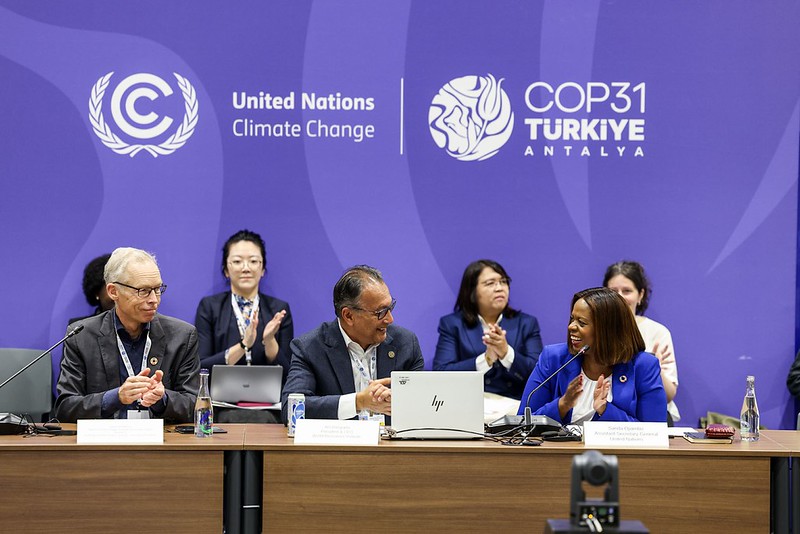
Building on these discussions, the UN Global Compact presented a new paper on scaling clean energy. Developed with institutional partners after private-sector consultations held between June and October 2026, including at the UN General Assembly Private Sector Forum,the paper responds to the 2025 report of the UN Secretary-General, Seizing the Moment of Opportunity.
The paper names three barriers businesses need to overcome:
- Expanding electricity grids
- Lowering the high cost of capital
- Financing long-term clean energy purchasing agreements
Overcoming these barriers will require closer cooperation between business, financial institutions and Governments. The paper sets out practical recommendations to turn corporate climate commitments into investment at scale.
2. Circularity is a collective effort
During Collective Action for Circularity: Enabling Business Action across Industry and Value Chains, convened by the UN Global Compact with support from UNEP and the UN Industrial Development Organization (UNIDO), participants shared lessons from establishing circular practices. They focused on challenges that no single company can solve alone, from product design and reverse logistics to who pays for end-of-life.
3. People must be at the centre of the transition
Businesses must build decent work, skills, social dialogue and human rights due diligence into their transition plans.
At Scaling Responsible Business Conduct for a Just Transition, held at the International Labour Organization (ILO) Just Transition Pavilion, the UN Global Compact joined the Organisation for Economic Co-operation and Development (OECD), the ILO and Global Compact Network Türkiye to explore how the just transition mechanism under negotiation at COP31 can link international commitments to business action.
4. National priorities shape global action
Network Türkiye led a series of engagements at the United Nations Türkiye Pavilion. On 12 November, it brought together representatives from 11 Country Networks for a roundtable on the role of business in an inclusive net-zero economy. They discussed how transition plans, inclusive workforce practices and transition finance can work together.
Those discussions fed into a high-level panel—From Dialogue to Delivery: Business Recommendations for COP31. There, the Network presented recommendations from its COP31 Roundtable Series to inform the Action Agenda of the COP31 Presidency. A further session looked at how to speed up decarbonization in heavy industry in Türkiye and beyond.
5. Implementation is the business case
The time for talk is behind us. Companies must now move to implementation and deliver on their targets. At the Sustainable Innovation Forum, UN Global Compact CEO and Executive Director Sanda Ojiambo set out what implementation means for business in practice.
Delivery depends as much on the systems around business as on business itself. Grids and policy certainty were central to the High-Level Event on the Global Grids Accelerator and the launch of the Taskforce on Net Zero Policy report. Both reinforced that corporate demand for clean energy can only develop into new capacity when infrastructure and policy keep pace.
What comes next
As COP31 moves from negotiation to implementation, the UN Global Compact will continue working with businesses, Governments and financial institutions to mobilize investment behind climate ambition. Through its global network and collective action platforms, the UN Global Compact will help companies align business decisions with national climate priorities and turn commitments into results.
Across energy, circularity, resilience and a just transition, business must be an active partner in shaping the next phase of climate action.