
Siren Analytics: Supporting Elections Across 1,000+ Municipalities through Youth-Led Governance Innovation
Start Reading

1. Company at a Glance
In this case study, we explore how Siren Analytics used its Youth4Governance programme to support Lebanon’s 2025 municipal elections while strengthening public- sector capacity. By embedding 19 multidisciplinary university students within the Ministry of Interior and Municipalities and combining governance expertise with responsible digital tools, the initiative supported election operations across more than 1,000 municipalities and helped manage over 5,300 enquiries with a 95% response rate. The systems, processes and capabilities developed through the programme also continued to support the Ministry beyond the municipal elections.
The case illustrates Transformational Governance: an approach through which businesses strengthen their own governance and work with others to support accountable institutions and the enabling environment in which they operate. Siren’s contribution centres on applying its expertise, investing in young talent and collaborating with government and academia to strengthen public-sector capabilities. This also broadens the business-value story: alongside relationships, talent and future opportunities, Siren contributes to the institutional environment on which its work depends.
Siren Analytics is a GovTech and public-sector transformation company that combines digital technology, data, AI and change management to help organizations improve services and institutional performance.
Governance Advisory, Public Sector Innovation and Digital Transformation
Industry
2019
Founded
Beirut, Lebanon
Headquarters
84
Number of Employees
Lebanon, Jordan, the Middle East and other fragile contexts, with offices in Beirut, Amman and Dublin
Global presence
2. The Challenge
Strengthening public-sector capacity while investing in the next generation of leaders
Siren Analytics identified a dual challenge in Lebanon’s public sector: strengthening the capacity of public institutions to respond more efficiently and transparently to citizens, while building a new generation of professionals equipped to contribute to public-sector reform. The company saw long-term governance resilience as dependent not only on institutional processes and technology, but also on investment in local talent and stronger collaboration between government, academia and the private sector.
Lebanon’s 2025 municipal elections provided an opportunity to apply this approach in a demanding operational environment. Following a governmental transition, election preparations took place under significant time constraints and required rapid coordination across complaints management, citizen communications, media monitoring and election operations. Siren therefore sought to use the fifth edition of Youth4Governance to bring multidisciplinary young professionals into the Ministry’s work while supporting more responsive, transparent and technology-enabled election management.
3. The Action
Embedding young talent and responsible innovation into election management
BUILD A CROSS-SECTOR PARTNERSHIP AROUND INSTITUTIONAL NEEDS
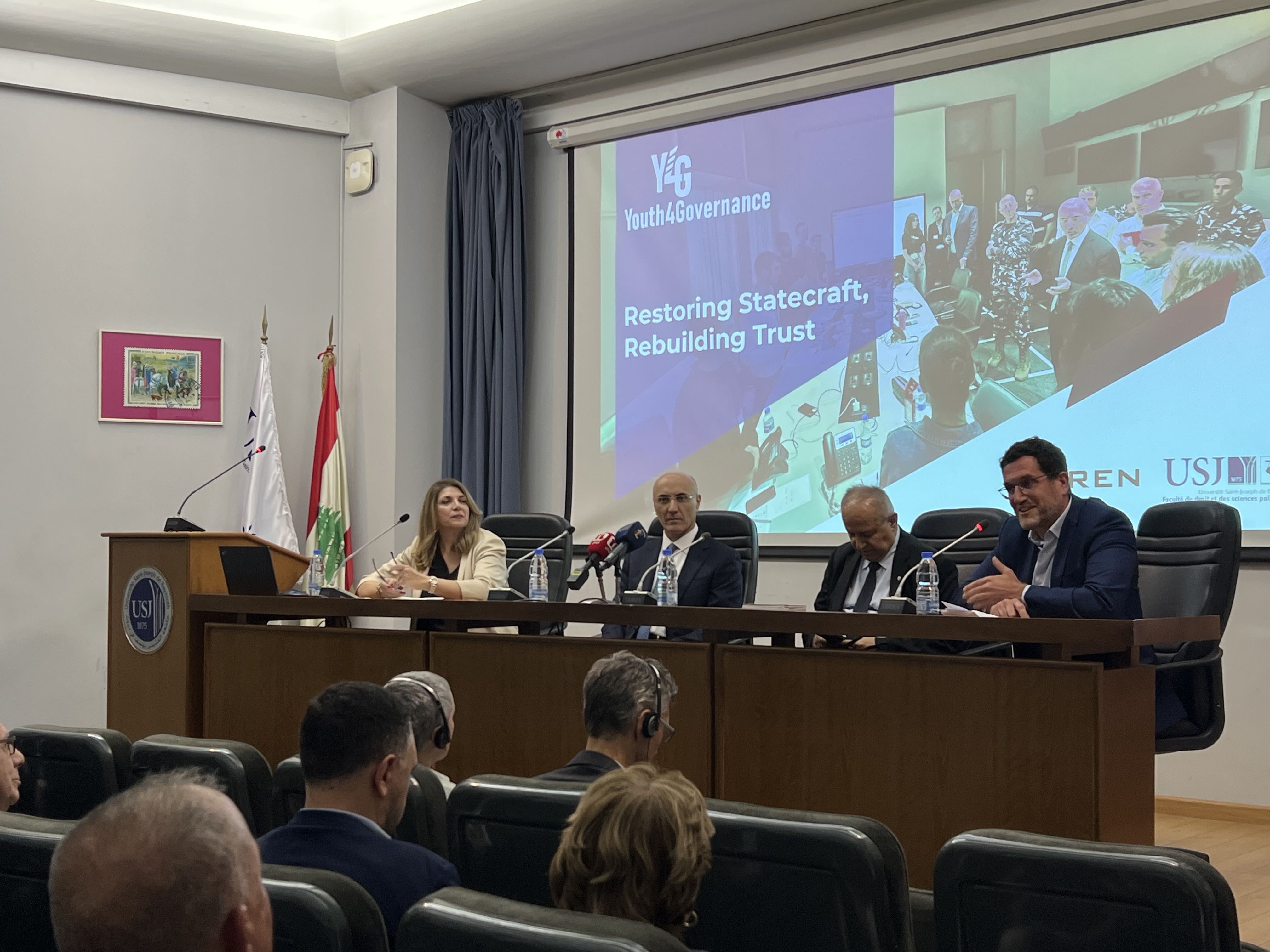
Siren implemented the fifth edition of Youth4Governance in partnership with Université Saint-Joseph (USJ) and Lebanon’s Ministry of Interior and Municipalities. Each partner contributed a different role: Siren led the initiative and coordinated implementation; USJ provided academic and methodological support; and the Ministry provided the operational environment where participants could work on real institutional priorities.
Rather than running Youth4Governance as a standalone internship programme, the partners integrated participants into ongoing election preparations. This allowed the programme to combine practical experience for young professionals with support for the Ministry’s operational and institutional needs.
SELECT, EMBED AND EQUIP MULTIDISCIPLINARY YOUNG PROFESSIONALS
Siren used a selection process to identify university students from different academic backgrounds who could contribute to the 2025 municipal elections. The selected participants were embedded in the work of the Ministry and given responsibilities across election operations, complaints management, media monitoring, citizen communications and technology-supported engagement.
This multidisciplinary approach allowed participants to contribute across legal, operational, communications and technology-related tasks while working alongside Ministry officials. Siren coordinated the collaboration between the students, government teams and university partners, while Ministry leadership provided operational guidance.
This practical experience was complemented by a comprehensive training programme delivered by Siren, designed both to strengthen participants’ contribution to the immediate project and to prepare them for future roles in public-sector leadership.
INTRODUCE DIGITAL TOOLS TO IMPROVE CITIZEN ACCESS AND OPERATIONAL RESPONSIVENESS
Working with Ministry teams, Siren and Youth4Governance participants introduced digital tools designed to support election management and citizen communication. These included a customized complaints- management system based on osTicket, interactive dashboards and a 24/7 AI-powered chatbot that provided access to election information and helped reduce pressure on Ministry services.
Participants also supported digital communications by monitoring and publishing voter-turnout information and election updates. The tools were implemented with human oversight, access controls and safeguards intended to maintain accountability and integrity in their use.
REDESIGN ELECTION-MANAGEMENT PROCESSES, NOT ONLY THE TECHNOLOGY
The programme went beyond introducing new tools. Drawing on previous election complaints, legal decisions and administrative processes, the project team identified recurring operational challenges and supported the optimisation of the Ministry’s operating procedures through the introduction and integration of weekly debriefs to summarise and review lessons learnt and to facilitate strategic planning for the coming week. This led to clearer governance structures and more integrated workflows.
This combination of process redesign and technology was intended to strengthen coordination inside the Ministry rather than create parallel systems managed externally by the programme.
COMBINE EXTERNAL FUNDING WITH SIREN’S OWN RESOURCES AND INSTITUTIONALIZE THE APPROACH
Dutch funding supported specific components of the municipal elections project, including programme design, intern fees and a limited number of staff days from Siren team members. Siren covered the remaining implementation costs, including fieldwork and other project expenses.
Alongside the operational work, the programme placed emphasis on knowledge transfer and longer- term institutional capacity. An Electoral Management Manual was developed as a reference for future elections, while the systems and working practices introduced through the programme were designed to be usable by Ministry teams beyond the immediate electoral cycle.
The municipal elections project represented the fifth iteration of Youth4Governance, building on a programme model that Siren has continued to develop with public institutions and university partners.
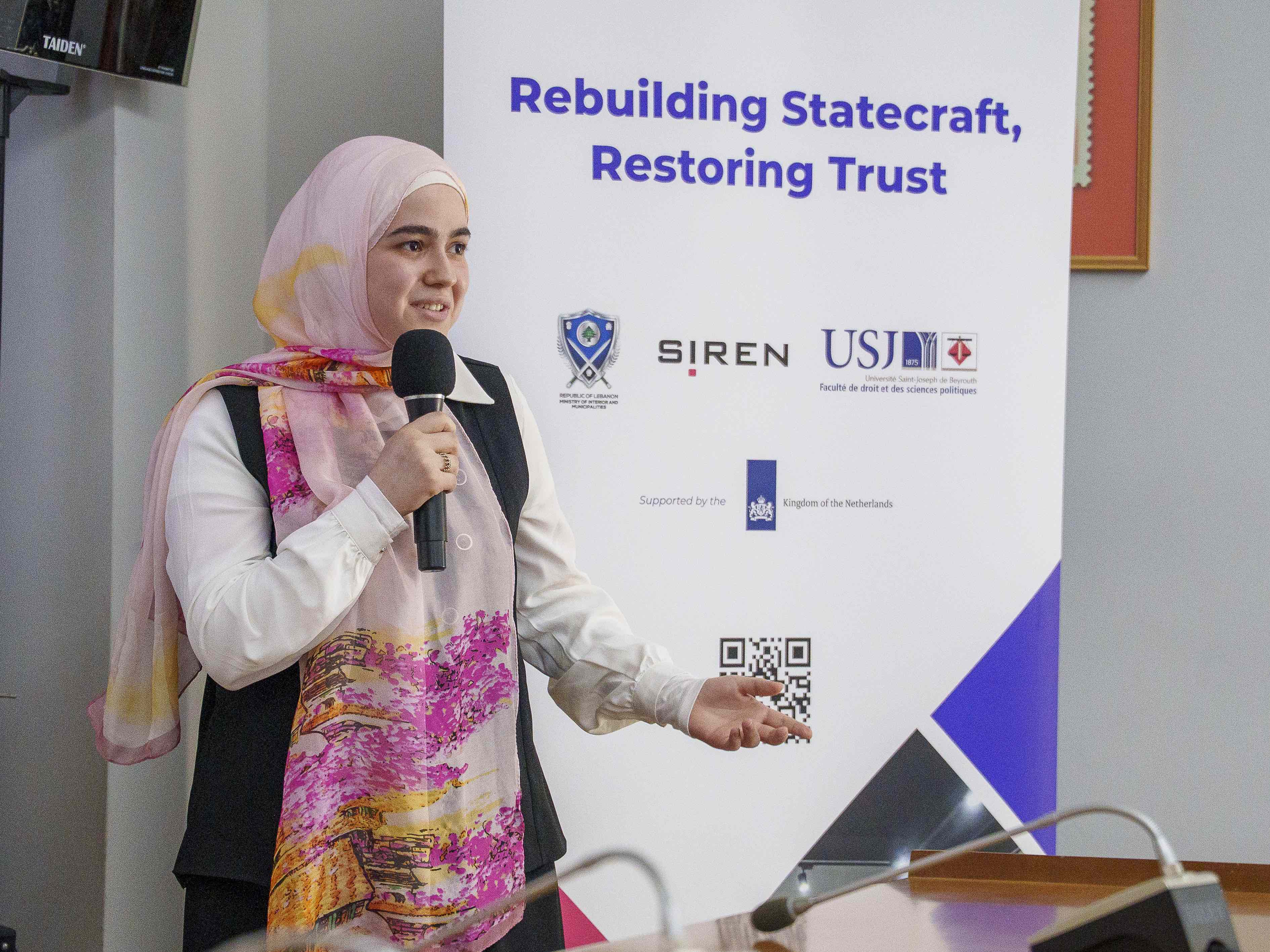
"The youth didn’t just observe, they delivered. Their presence inside the Ministry created a unified team that helped ensure credible, transparent elections.”
Ahmad al-Hajjar, Minister of Interior
4. Overcoming Barriers
Delivering institutional change under a compressed election timeline
The 2025 municipal elections followed a governmental transition and were prepared under significant time constraints. This required the team to coordinate and implement new approaches within a very short window while the Ministry managed a complex national electoral process. Siren responded by assembling multidisciplinary participants who could work across several operational areas simultaneously and by coordinating closely with Ministry officials and university partners. Digital tools were introduced to support communication, complaints management and access to information, while participants were embedded directly in operational teams rather than working through a separate project structure.
5. Impacts & Results
Election Operations at National Scale
1,000+ municipalities supported during Lebanon’s 2025 municipal elections.
~ 14,414 civil servants mobilised across 26,000+ election roles.
1890 polling centers.
10+ public institutions involved.
Long-Term Institutional Capacity
An Electoral Management Manual developed as a reference for future elections.
Systems and processes introduced through the programme remained in use beyond the municipal elections, including for parliamentary election preparations, national events and official visits.
The programme contributed to a lasting shift in the Ministry’s working culture, embedding a more proactive, data-driven, innovative and analytical approach to operations, decision-making and collaboration.
Youth-Led Governance Innovation
19 university students embedded in the Ministry of Interior and Municipalities.
4 AI agents built and piloted to support call-centre operations, media monitoring, turnout tracking and administrative coordination.
Citizen Responsiveness
5,300+ enquiries and complaints handled.
95% answer rate at the call centre.
9 seconds average waiting time.
43 seconds average call duration.
Business Value for Siren
By supporting public-sector capacity, Siren contributes to the enabling environment in which it operates. Stronger institutional capabilities and collaboration can create better conditions for responsible digital innovation and more effective public services.
The initiative also strengthened Siren’s relationships with public institutions and universities and increased its visibility among students and young professionals. These connections offer potential to attract talent, expand Youth4Governance and develop future business opportunities with existing and prospective partners.
6. Key Lessons Learned
Embed participants in real institutional processes, not parallel projects
Youth engagement created greater value when participants were integrated into the Ministry’s day-to-day operations and given responsibilities linked to real institutional priorities. For companies developing similar programmes, embedding participants within existing teams can support both practical learning and knowledge transfer, and facilitate innovative solutions and renewed momentum and motivation within existing institutions.
Combine technology with process and governance changes
Digital tools alone were not sufficient to strengthen election management. Their implementation was accompanied by clearer responsibilities, standard operating procedures, integrated workflows and human oversight. Similar initiatives should therefore treat technology as part of a broader institutional change process rather than as a standalone solution.
Allow enough time for testing, training and institutional adoption
The compressed election timeline required rapid implementation and limited the time available to test tools and prepare users. Looking back, Siren identified earlier integration of digital solutions and additional preparation time as opportunities to improve testing, training and institutional adoption.

"Youth4Governance showed us that lasting public-sector innovation is not only about introducing new tools, but about building the skills, processes and partnerships that allow institutions to keep improving after a project ends.”
Jana Chazbeck, Y4G Project Lead
7. Company Commitment
Siren Analytics has been a commited participant since 2023 in initiatives such as:

8. Recommended Resources
Recommended UN Global Compact Resources

Download Case Study
Disclaimer: This case example is intended strictly for learning purposes and does not constitute an endorsement of the individual companies by the UN Global Compact.