
The Business Strategy Behind Capgemini’s 15-Year Gender Equality Results
Start Reading

1. Company at a Glance
This case study examines how Capgemini, a global leader in business and technology transformation, addressed gender inequality in the technology sector through a comprehensive and long-term strategy helping the company reach 40.5% women in its global workforce and 30.5% women in executive leadership roles in 2025. Operating in an industry still largely dominated by men, the Group has made gender parity a strategic priority, embedding it across governance, talent management, pay equity, and throughout the employee life-cycle. Capgemini’s approach over 15 years illustrates how systemic change can be driven at scale through measurable objectives, cultural transformation and inclusive leadership.
AI-powered global business and technology transformation partner
Industry
1967
Founded
France
Headquarters
420,000
Number of Employees
50+
Global Presence
2. The Challenge
The technology sector continues to face a significant gender imbalance. Globally, women represent only 35% of STEM students, and less than 25% across Europe. Beyond education, retention remains a major issue, with more than half of women leaving the tech sector before the age of 35.
For Capgemini, it was a material issue affecting human capital, talent risk, innovation capacity, and increasingly, investor and regulatory scrutiny. The challenge was twofold: attracting more women into technology roles and ensuring they could get equal opportunities to build long, sustainable careers within the organization. This required addressing structural barriers such as underrepresentation in leadership, pay equity, work-life balance and persistent cultural biases, including unconscious bias and imposter syndrome.

3. The Action
Capgemini's Approach Rests on Six Interlocking Pillars:
SETTING CLEAR AND MEASURABLE GENDER REPRESENTATION OBJECTIVES AND TARGETS
Capgemini established quantified objectives to drive accountability and track progress across all levels of the organization. Monitoring women’s representation since 2010, the Group set first milestones by 2025, targeting 40% women across the total workforce and 30% women among executive leaders. As these goals have been met, the company extended their ambition to 2030: maintaining 40% overall representation, including business and core tech roles, and reaching 35% of women in executive positions.
Progress is monitored with increasing granularity across grades, functions and geographies, with a consolidated view of recruitment, promotions and retention in the Group’s 23 largest countries. Beyond CSR and HR communities, these results are regularly escalated to governance bodies: quarterly to the Group Executive Board, at least every semester to the Group Inclusive Board and annually to the Board of Directors.
EMBEDDING PAY EQUITY INTO GOVERNANCE
Beyond a voluntary Equal Promotion policy, ensuring women are fairly represented in promotions, pay equity was identified as a foundational pillar of gender parity. Capgemini integrated the principle of “Equal work – for Equal pay” into its Group Inclusion Policy. Annual internal reviews and external audits are conducted to identify and correct unjustified pay gaps, taking into account objective criteria such as skills, performance, seniority and location.
BUILDING A SUSTAINABLE TALENT PIPELINE ACROSS CORE ROLES AND LEADERSHIP
Internal Polices and processes were redesigned around four priorities:
- Improving gender-balanced sourcing and inclusive recruitment standards by redesigning recruitment processes end to end, including gender-neutral job descriptions, broader and more diverse candidate pipelines, blind screening practices, gender-balanced interview panels, bias awareness training for panelists and collective decision-making based on skills and potential.
- Increasing women’s presence in core technological and commercial roles by promoting on demand training and professional certifications through internal communication channels, HR outreach and employee networks, while using role models and peer exchange to build awareness, confidence and participation in sales and technical learning paths.
- Accelerating access to senior leadership through talent development, mentoring and sponsorship programs.
- Strengthening engagement and retention through flexible working arrangements, parental schemes and peer-to-peer support.
SUPPORTING WOMEN THROUGHOUT ALL STAGES OF LIFE
Capgemini adopted a life-cycle approach to inclusion, supporting women from early education through to the later stages of their careers. Early-stage Ace of STEM initiatives such as Elles Bougent in France, or Coding for Girls in India aim to improve the perception of STEM careers among girls. Hackathons and partnerships, including with FIRST and Girls in Science programs (Denmark), further encourage early engagement.
Key career transition periods receive targeted support. Parental leave departures and returns are anticipated, flexible working options are offered and family-support measures such as childcare partnerships and breastfeeding facilities are available in some countries. These policies are genderneutral and inclusive of all family structures. Career re-entry after long breaks is supported through the Captivate program, which combines training, mentoring and structured reintegration pathways. At the same time, health and well-being initiatives are being developed to support employees at different life stages, including women’s health topics such as endometriosis and menopause, alongside issues affecting men and broader discussions relevant to all genders.
DRIVING CULTURAL CHANGE AND ENGAGING MALE ALLIES
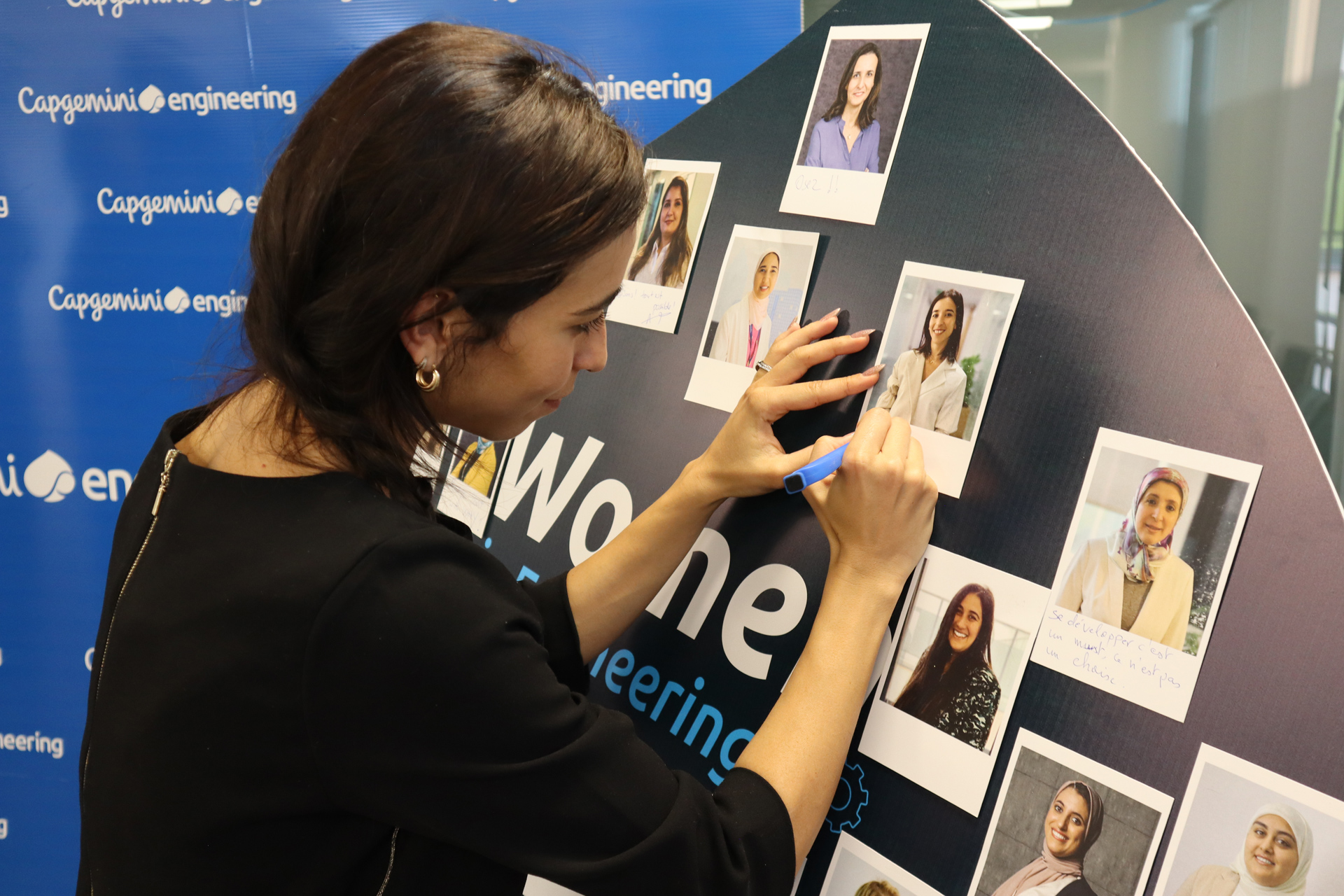
Capgemini has worked actively to foster a cultural shift toward inclusion, engaging men as allies in the parity journey. Initiatives such as the Women@Capgemini network are co-led by men and women, and Inclusion Circles discussions, led by senior leaders on real life scenarios, address unconscious bias, and how as a team to contribute every day to a workplace inclusive for all. Performance analysis systems are used to ensure fair identification of talent, reducing the impact of bias and imposter syndrome without creating undue advantage.
SOCIETAL EMPOWERMENT - SUPPORTING BEYOND THE WORKPLACE
As gender equality is interdependent with the representation and place of women in society, Capgemini promotes women’s inclusion in sport, through their Women in Rugby Leadership program and the sponsoring of top female competitions such as Le Tour de France Femmes or La Vuelta Femenina. Capgemini is also committed to fighting against sexism and domestic abuse, through education modules and external partnerships.

4. Overcoming Barriers
Implementing a consistent gender parity strategy across 50 countries, each with different labor markets and cultural norms, is harder than setting the ambition. Add persistent gender stereotypes and the risk of backlash, and the barriers are significant. Capgemini addressed them in the following ways:
Geographic scale and local variation:
With operations across many countries, Capgemini faced the challenge of implementing a consistent gender-parity approach while adapting to different labor markets, legal frameworks and cultural norms. The company responded with a glocal approach, aligning all countries on global principles and guidelines, strong governance on common KPIs, while allowing localization of measures.
From gender equality to inclusion for all:
Capgemini has a clear focus on gender equality, with a broader vision of inclusion. Women are not a homogeneous group, they have different ages, social and cultural origin, ability and health status and sexual orientation. Inclusion programs should thus cultivate commonalities, so that every progress benefits more people than the initially targeted group, and improves the overall employee experience.
Gender stereotypes live long:
Technical skills are still considered as male-dominated, as highlighted in a recent Capgemini Research Institute report, Gender and leadership: Navigating bias, opportunity and change. AI and data management are perceived as masculine by a majority of male leaders, while female leaders consider them gender neutral. Capgemini continues to address this perception gap by investing early in community outreach and skillbuilding to broaden exposure, and create clearer pathways into tech roles, while extending flexible work and support options to men and equipping managers with training programmes and toolkits on unconscious bias and inclusion.
5. Impacts & Results
40.5% women in the global workforce in 2025 (+6.8 pts versus 2020, and +14 pts versus 2010)
30.5% in executive leadership roles in 2025 (+10.2 pts versus 2020)
Five countries have already reached or exceeded gender parity, with women representing 50% or more of the workforce in China, Poland, Morocco, Guatemala and Romania.
74K+ people graduated from digital academies, 9.5K directly hired by Capgemini, of which 50% are women.
Close to 70K employees engaged in Capgemini Employee Network Groups. More than 3,700 Inclusion Circles led in total, with more than 60K participants.
Impact recognized externally, for example earning the Group an Equileap Gold Seal for gender equality.
6. Key Lessons Learned
Gender parity in tech requires a systemic, long-term approach, mobilizing the entire ecosystem.
Ambitious objectives, measurable KPIs and strong governance are essential to drive accountability at each level of the organization. A single global headline number allows underperforming units to hide. Capgemini tracks by grade, function and geography, making accountability specific and unavoidable.
Retention is as important as recruitment. Many gender programs over-invest in hiring and under-invest in retaining women through career transitions. The biggest losses happen at family leave, mid-career and post-50, all of which require targeted, proactive intervention.
Awareness and support should start from primary school, and the investment in STEM education from the local governmental education system is key to create a rich and balanced talent pool.
Cultural change accelerates when men are actively engaged as allies and when inclusion strategies embrace all employees. Programmes that position inclusion as a “women’s issue” limit their own reach. Capgemini’s model and male allyship approach multiplied the cultural impact of every initiative.

"We need more women in leadership not because their skills differ. When women lead, organizations benefit from the full spectrum of talent that already exists; our job is simply to remove the barriers that prevent that talent from rising.”
Karine Vasselin, Group Head of Inclusive Futures, Capgemini Group
7. Company Commitment
Capgemini has been an active participant of the UN Global Compact since 2004.
8. Recommended Resources
Recommended UN Global Compact Resources



Download Case Study
Disclaimer: This case example is intended strictly for learning purposes and does not constitute an endorsement of the individual companies by the UN Global Compact.